This blog was established four years ago, with the intention of offering a window to the research published in IEEE JSAC, promoting the special issues, and getting insights from the Guest Editors about the topics featured in their special issue. The trend started with the previous Editors-in-Chief has continued and the impact factor rose to 17.2. It�maintains its position as the second-ranked journal in communication engineering, surpassed only by IEEE Communications Surveys & Tutorials, as well as stays among the top ranked journals in Electrical Engineering overall. Critics would correctly point out that the impact factor is not the only thing that matters for a journal and should not be the single objective to optimize for. Yet, it is still one of the important indicators and an attractor for quality submissions.
The other important indicator, specific to IEEE JSAC, is the set of topics of the special issues.�The journal has hosted special issues that reflect the community’s evolving focus, such as the growing role of AI in all aspects of communication systems, interplay of communication with computation and sensing, or programmable wireless environments. However, in addition to the proposals initiated by the aspiring Guest Editors, we have also solicited proposals on specific topics that are of interest to the communication community but are often published in venues outside of the IEEE Communications Society. Examples include�Internet Routing and Addressing,�Optical Communication and Networking, or�Wi-Fi and other unlicensed technologies. We have also started a new�Series on Quantum Communications and Networking, intended to capture the increased focus of the IEEE Communications Society on this rapidly growing area.
While the topics and the research related to them made the headlines in this blog, there were also changes on the administrative side. We have transferred the journal from EDAS to ManuscriptCentral. Before starting the process, it looked to me like a stroll in the park, but it turned out to be a more significant tectonic event whose ripples are still causing delays in our special issues.� On the policy side, we have introduced the restriction that a person cannot be a Guest Editor of more than one active issue at a time (from initiation to final accepted papers). Doing a proper Guest Editorship requires time and resources and prior experience says that, on average, it is not possible for a person to carry out more than one of those roles properly. Here properly means, for example, spending the time to find relevant reviewers, read their reviews and, instead of doing majority voting, use Editorial insight to make the decision as well as to support the decision with a nontrivial Editorial letter. We have specified these and other rules in the detailed Guidelines for Editors, but we are aware that this is not followed in 100% of the cases. For instance, one of the rules says that at most one reviewer among the reviewers should be a person that submitted a paper in the same special issue. This has clearly a game-theoretic motivation, to prevent having too many reviewers that are incentivized to downgrade the paper in order to make sure that their submission stands out as a better one for the Guest Editorial team. Some changes were made on the authorship policy as well. For instance, the Editor-in-Chief is explicitly prohibited from submitting papers to IEEE JSAC. The latest one that is in the process of being introduced is that a single person cannot coauthor more than three papers submitted to the same special issue.�
All these and other measures have the objective of contributing to the safeguarding of the scientific integrity of the journal, with clearer conflict-of-interest rules, discouragement of incremental scientific overproduction, as well as systematic handling of ethical concerns and review anomalies. The set of rules and policies is far from perfect and is evolving as we are learning more about the threats to the scientific quality and integrity of the journal.�
For all these achievements, I am deeply grateful to the authors, reviewers, Guest Editors, Senior Editors, Executive Editor, and the IEEE staff.
Three Lessons from Serving as Editor-in-Chief
The first lesson is the significant difference between the editorial teams in standard journals and Guest Editors for a special issue. As an Area Editor in a regular IEEE journal, I worked with a group of Editors, some of which I had recruited, over a longer time. This offered a good estimate of the performance and expertise of each Editor, and the possibility for improvement over time towards a stage where the quality and timeliness of the Editorial decision were predictably high. Unlike that, Guest Editors are inherently more unpredictable than the standing Editorial Board. This is even more true when we insist that the Guest Editorial teams are diversified and more opportunities are given to new names to take the Guest Editorial position. Thus, in some sense, the rule that restricts the Guest Editors to a single active special issue poses a challenge, as we can rely less on people that have built extensive experience as Guest Editors over the years. Determining whom to entrust with responsibility becomes less about rewarding good intentions and more about carefully securing reliability and responsiveness.
The second lesson is that every measure meant to protect the integrity of the journal comes with extra work for someone. It is easy to agree, in principle, that certain checks and constraints are “obvious” and “fair”; it is harder to find volunteers to implement them in practice, repeatedly, under time pressure. This tension between what the community declares as desirable and what it is practically willing to support is one of the hidden constants of journal leadership.
The third lesson is that, as every realistic noisy communication channel, the review process is not perfect and can lead to errors. Even if IEEE JSAC works under stringent deadlines and not every complaint from authors is well-grounded, we read carefully each complaint and discuss it it with the Guest Editors and Senior Editors. Keeping a good paper out can be as damaging as accepting a bad one, although the harm materializes in different ways and on different timescales. Balancing these risks requires a vigilance and a culture where editors can admit that a process, or a specific decision, did not work as intended.
Thoughts on AI and Publishing
I am leaving the position of Editor in Chief at the time of serious intertwining of AI and the publication of scientific papers. Indeed, the current AI tools used for scientific papers are the worst tools that will ever be used; this is because AI will only become better in the years that come. Traditionally, papers are authored, reviewed and, finally, studied by humans. AI gets a share in all three steps. Authors use AI tools to refine language, generate figures, explore related work, and even to draft substantial parts of a manuscript. Reviewers increasingly rely on AI to summarize papers, check consistency, or even sketch a first review that they then edit. In the extreme case, a reviewer may only ask the AI tool to review the paper and then just make a micro-effort to remove the obvious marks of AI in their review. Then the people studying the papers may use AI tools for summarization or clarification.
AI will obviously increase the production of scientific papers. It is possible to imagine a pipeline where authors sketch an idea, ask AI to generate a full paper, iteratively improve it by simulating multiple rounds of “virtual peer review,” and submit only once it appears robust against automated criticism. On the other side, reviewers may channel the same paper through AI systems that generate structured comments and recommendations. All this leads to a large number of write-review-revise rounds within a short time interval. The result is that the throughput of published papers created by this human–machine loop can be far higher than anything seen before, even if the underlying human capacity to absorb information has not changed. I tend to call this Zeno publishing, after the philosopher�Zeno of Elea, who considered increasingly shorter time intervals in stating his paradoxes of motion.
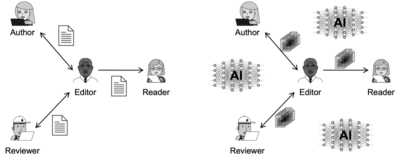
This poses the important question: Who will be the peer in “Peer Review” of scientific publications? And what will be the role of the Editor-in-Chief ten years from now? It is difficult to answer these questions precisely, but the IEEE community is already taking steps to deal with the presence of AI in the publishing process. My personal opinion is that, over the longer period, the entire humans-in-the-scientific-publishing loop process requires rethinking to accommodate the level of automation introduced by the increasingly more powerful AI. Figure 1 tries to capture the spirit of this change. The challenge for publications like IEEE JSAC will be to adapt workflows, editorial policies, and quality criteria to this new landscape, while remaining faithful to the core values of rigor, scientific curiosity, and advancement of the human intellectual horizon. I hope IEEE JSAC will lead the way in defining what high-quality, responsible publishing will mean in the age of AI.
Statements and opinions given in a work published by the IEEE or the IEEE Communications Society are the expressions of the author(s). Responsibility for the content of published articles rests upon the authors(s), not IEEE nor the IEEE Communications Society.